
Introduction
For small and medium-sized enterprises (SMEs), every marketing dollar matters. While digital marketing offers immense opportunities for business growth, many businesses struggle to determine how much they should invest and where their budget should be allocated. Effective Digital Marketing Planning ensures that marketing expenses generate measurable returns while supporting long-term business objectives.
A well-structured digital marketing budget helps SMEs attract more customers, improve brand visibility, and maximize return on investment (ROI) without overspending.
Why Digital Marketing Budget Planning Is Important
Many businesses invest in digital marketing without a clear strategy, leading to wasted resources and inconsistent results. Proper Digital Marketing Planning allows businesses to allocate their budget strategically across different channels and campaigns.
Key benefits of budget planning include:
- Better resource allocation
- Improved ROI tracking
- Consistent lead generation
- Enhanced brand visibility
- Reduced marketing waste
- Clear performance measurement
By establishing a structured budget, SMEs can focus on activities that deliver the highest business impact.
Define Your Business Goals First
Before deciding on a budget, businesses must identify their primary objectives. Different goals require different marketing investments.
Common SME marketing goals include:
Brand Awareness
Businesses looking to increase visibility may focus on social media marketing, content creation, and display advertising.
Lead Generation
Companies seeking inquiries and prospects often invest in Google Ads, SEO, and landing page optimization.
Sales Growth
E-commerce businesses may allocate more resources to paid advertising, conversion optimization, and email marketing.
Customer Retention
Businesses focused on repeat sales often prioritize email campaigns, loyalty programs, and customer engagement strategies.
Effective Digital Marketing Planning starts with clearly defined business objectives.
Understand Your Marketing Channels
A successful budget should be distributed across multiple marketing channels based on business priorities.
Search Engine Optimization (SEO)
SEO helps businesses generate long-term organic traffic and reduce dependency on paid advertising. While SEO requires ongoing investment, it often provides one of the highest long-term returns.
Google Ads
Google Ads can generate immediate visibility and leads. Businesses targeting high-intent customers often allocate a significant portion of their budget to paid search campaigns.
Social Media Marketing
Platforms like Facebook, Instagram, LinkedIn, and YouTube help businesses increase brand awareness and engage with their audience.
Content Marketing
Blog posts, videos, case studies, and guides improve SEO performance while building trust with potential customers.
Email Marketing
Email marketing remains one of the most cost-effective channels for nurturing leads and retaining existing customers.
Balanced Digital Marketing Planning ensures that businesses do not rely solely on one marketing channel.
Determine Your Marketing Budget
While there is no universal rule, many SMEs allocate between 5% and 15% of their annual revenue toward marketing activities. The exact amount depends on factors such as industry competition, growth goals, and current market position.
For example:
- New businesses may invest more aggressively to build awareness.
- Established businesses may focus on maintaining market share and customer retention.
- Competitive industries may require larger budgets for paid advertising and SEO.
A realistic budget should align with both short-term and long-term growth objectives.
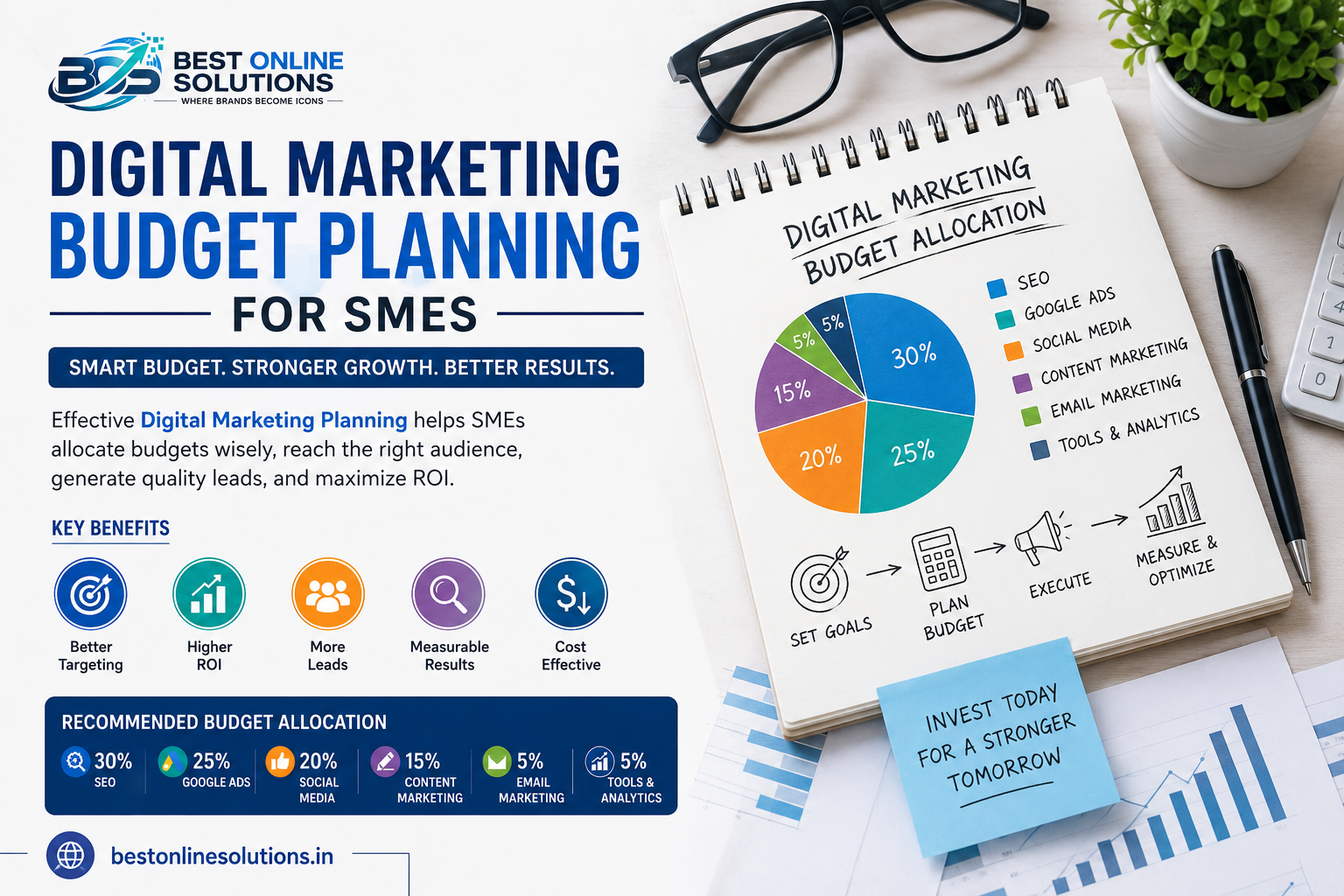
Recommended Budget Allocation for SMEs
A balanced digital marketing budget may look like this:
- SEO: 30%
- Google Ads: 25%
- Social Media Marketing: 20%
- Content Marketing: 15%
- Email Marketing and Automation: 5%
- Analytics and Tools: 5%
The exact distribution should be adjusted based on business goals and industry requirements.
Strategic Digital Marketing Planning helps businesses optimize spending across these channels for maximum effectiveness.
Track Key Performance Indicators (KPIs)
Budget planning does not end after launching campaigns. Businesses must continuously monitor performance using measurable metrics.
Important KPIs include:
- Website traffic
- Cost per lead (CPL)
- Conversion rate
- Customer acquisition cost (CAC)
- Return on ad spend (ROAS)
- Customer lifetime value (CLV)
Regular performance analysis ensures marketing investments continue delivering positive results.
Avoid Common Budget Planning Mistakes
Many SMEs make budgeting mistakes that reduce campaign effectiveness.
Ignoring SEO
Focusing only on paid advertising can increase marketing costs over time. SEO provides sustainable long-term growth.
Underestimating Content Creation
Quality content is essential for SEO, lead generation, and customer engagement.
Lack of Tracking
Without analytics and reporting, businesses cannot accurately measure ROI.
Spending Too Much on One Channel
Diversification reduces risk and improves overall marketing performance.
Strong Digital Marketing Planning requires regular evaluation and adjustment based on performance data.
Future-Proof Your Marketing Investment
Digital marketing trends continue to evolve with advancements in artificial intelligence, automation, personalization, and customer behavior. SMEs should reserve a portion of their budget for testing new platforms, tools, and strategies.
Businesses that adapt quickly to changing digital trends often gain a competitive advantage and achieve faster growth.
Conclusion
Effective Digital Marketing Planning is one of the most important factors in achieving sustainable business growth. By setting clear goals, allocating resources strategically, tracking performance, and optimizing campaigns regularly, SMEs can maximize their marketing ROI and generate consistent results.
Rather than viewing digital marketing as an expense, businesses should consider it a long-term investment that drives visibility, leads, customer engagement, and revenue growth. With proper planning and execution, SMEs can compete effectively in today’s digital marketplace and achieve their growth objectives.